


Anthocyanin-Induced Alterations in Substrate Oxidation During Exercise: A Narrative Review
Study Details
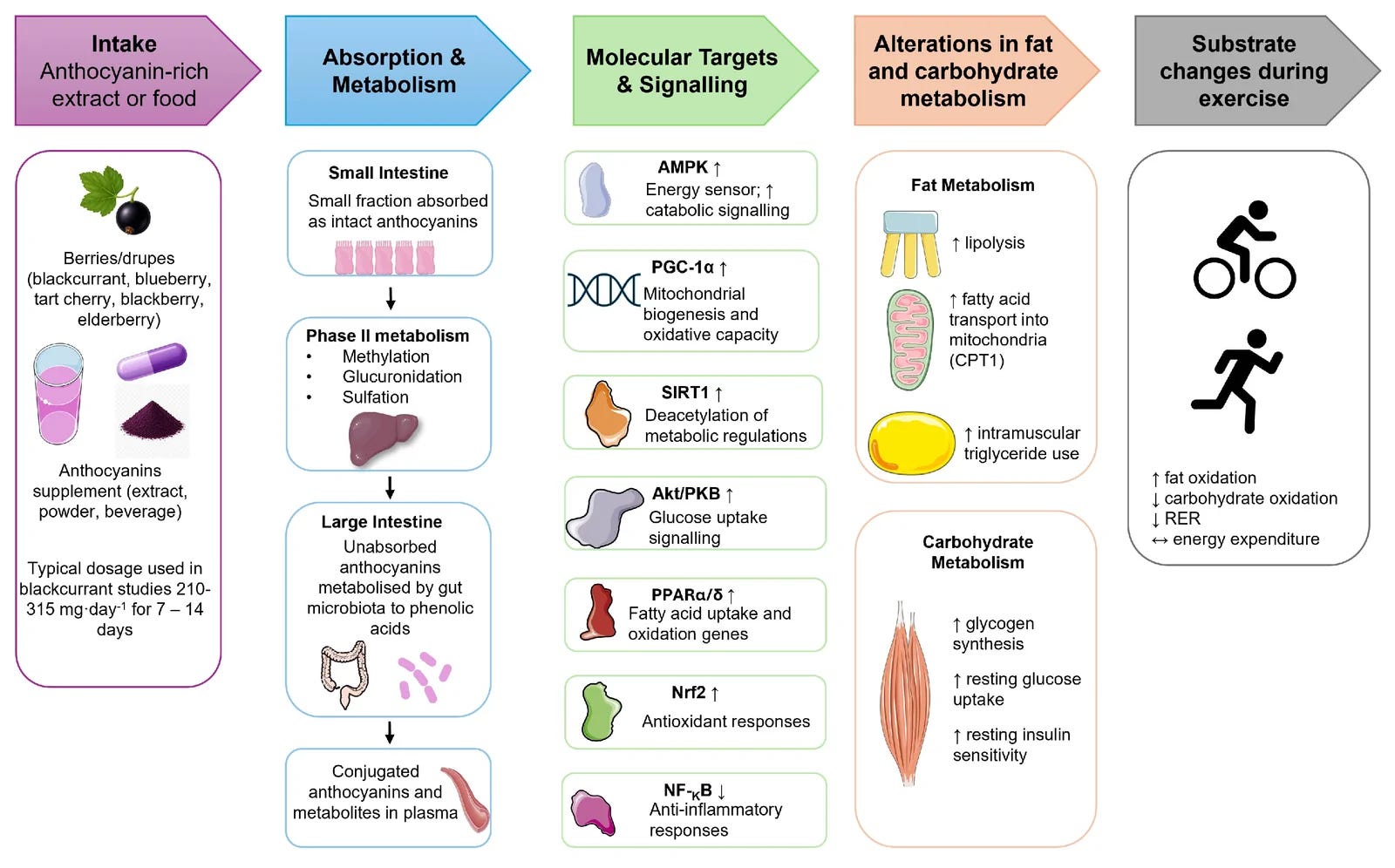
This narrative review included 23 studies examining whether anthocyanin-rich foods and supplements alter fat and carbohydrate oxidation during exercise 🔍
Here are the key findings ⬇️
Key Findings
🫐 New Zealand blackcurrant extract had the strongest and most consistent evidence
🔥 After ~7–14 days of supplementation, several studies reported ~15–30% higher fat oxidation during continuous moderate-intensity exercise
🍞 This was often accompanied by ~5–12% lower carbohydrate oxidation
🚴 Benefits were observed across cycling, walking and running, including in some endurance-trained athletes
⏱️ Acute supplementation generally did not produce the same effect, suggesting repeated intake may be important
📅 In one study, daily dosing altered substrate use whereas every-other-day dosing did not
🧬 Mechanistic evidence suggests blackcurrant may increase intramuscular triglyceride use and alter muscle glycogen availability
↔️ Energy expenditure and oxygen consumption were generally unchanged, indicating a shift in fuel selection rather than greater calorie expenditure
🫐 Evidence for other anthocyanin-rich sources was less consistent: blueberry showed some positive findings, while tart cherry generally did not alter substrate oxidation
🧩 Responses may depend on baseline fuel use, body composition, supplementation duration, diet and environmental conditions
⚠️ Much of the blackcurrant evidence comes from relatively small studies and a limited number of research groups
☝️ Importantly, higher fat oxidation does not yet mean better endurance performance, glycogen sparing or greater fat loss
Conclusion
For endurance athletes, ~7–14 days of anthocyanin-rich blackcurrant supplementation may shift moderate-intensity exercise toward greater fat and lower carbohydrate use, but whether this meaningfully improves performance remains uncertain ✅
Reference
https://pubmed.ncbi.nlm.nih.gov/42797001/

Performance Nutrition Digest is powered by Healthspan Elite ⚡️
Healthspan Elite is a science-led sports nutrition range developed in collaboration with leading experts to support athletic performance, recovery, and health.
Use code: TCDIGEST25 for 25% off at https://www.healthspanelite.co.uk/ 💪
Cook, Bateman and Willems provide a useful account of anthocyanin-induced changes in substrate use during exercise. However, their own conclusion that New Zealand blackcurrant extract can increase fat oxidation “without alteration of total energy expenditure” sets a strict limit on any implication for body-weight management. [1]
A higher rate of fat oxidation during an exercise bout, especially when accompanied by lower carbohydrate oxidation, describes a change in fuel selection, not an increase in energy dissipation. It cannot by itself establish a net loss of adipose tissue. To make such a claim, one would need evidence of a sustained negative energy balance and, ultimately, of a negative fat balance or a change in body composition.
This is not a semantic distinction. The interpretation of respiratory quotient as an intrinsic ability to “burn fat” has been critically re-examined. In a review of 42 studies, Péronnet and Haman found no convincing experimental support for the proposition that low fat oxidation predisposes individuals to obesity. They also showed that, under a stable diet, 24-hour respiratory quotient is determined by food quotient and energy balance; fasting respiratory quotient additionally reflects glycogen stores. It is therefore not a direct measure of a person's innate capacity to oxidise fat. [2]
The same principle is illustrated by experimental work in rodents. Acute and chronic interventions that increased fatty-acid oxidation without increasing energy demand shifted oxidation away from glucose, but produced no net increase in energy expenditure or reduction in adiposity. [3] This reciprocal pattern is also prominent in the studies reviewed by Cook et al.
Anthocyanin supplementation may still deserve study in endurance sport—for example, if glycogen sparing affects exercise tolerance or recovery. But a transient increase in fat oxidation is not evidence for fat loss. Research and public communication should therefore stop treating “more fat burning” as a weight-loss target, and instead assess the outcomes that matter: energy intake, total energy expenditure, long-term fat balance, and body composition.
References
1.
Cook MD, Bateman JL, Willems MET. Anthocyanin-induced alterations in substrate oxidation during exercise: a narrative review. Nutrients. 2026;18(18):3018. doi:10.3390/nu18183018.
2.
Péronnet F, Haman F. Low capacity to oxidize fat and body weight. Obesity Reviews. 2019;20:1367–1383. doi:10.1111/obr.12910.
3.
Hoehn KL, Turner N, Swarbrick MM, et al. Acute or chronic upregulation of mitochondrial fatty acid oxidation has no net effect on whole-body energy expenditure or adiposity. Cell Metabolism. 2010;11:70–76. doi:10.1016/j.cmet.2009.11.008.