


Application of 13C MRS demonstrates carbohydrate feeding spares muscle but not liver glycogen utilization during high-intensity interval exercise
Study Details
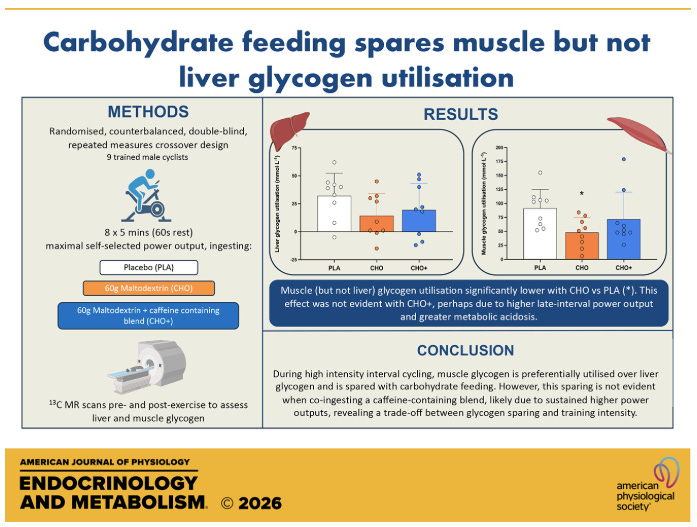
This new study used ¹³C magnetic resonance spectroscopy to examine liver and muscle glycogen use during HIIT in 9 trained male cyclists 🔍
Participants completed 8 × 5-min maximal self-selected intervals with 1-min recovery 🚴
Trials compared placebo, 60 g/h carbohydrate, and carbohydrate plus a caffeine-containing multi-ingredient blend 🥤
Key Findings
💪 Without carbohydrate, muscle glycogen fell by ~50% across the session
🍞 Carbohydrate feeding reduced muscle glycogen utilisation by around 40% versus placebo
🧬 This provides direct evidence that exogenous carbohydrate can spare skeletal muscle glycogen even during high-intensity interval exercise
🫀 Liver glycogen use was comparatively small, averaging only ~12 g during the ~48-min session
↔️ Carbohydrate did not significantly spare liver glycogen, although utilisation was numerically ~5 g lower than placebo
🩸 Glucagon was lower with carbohydrate feeding, but plasma glucose remained similar between conditions
☕ Muscle glycogen sparing was not evident when carbohydrate was combined with caffeine, L-theanine, taurine, L-citrulline and citicoline
⚡ Importantly, this multi-ingredient condition produced ~2.8–3.8% higher power output during the final four intervals
🔥 Higher power was accompanied by greater lactate accumulation and greater disturbance to bicarbonate, base excess and pH
Conclusion
The lack of glycogen sparing with the caffeine-containing blend therefore probably reflected more work being performed, rather than caffeine directly accelerating glycogen breakdown 🧐
Exploratory results suggested some improvements in attention and reaction time with the multi-ingredient treatment, but these findings were not definitive 🔍
This study reinforces that muscle glycogen is the dominant glycogen source during HIIT, whereas liver glycogen contributes relatively little over this duration 🔋
Taking carbs during hard interval sessions may preserve muscle glycogen for subsequent training, while adding caffeine may allow athletes to sustain greater late-session intensity, effectively trading some glycogen sparing for higher training output ✅
Reference
https://journals.physiology.org/doi/full/10.1152/ajpendo.00139.2026
Performance Nutrition Digest is powered by Healthspan Elite ⚡️
Healthspan Elite is a science-led sports nutrition range developed in collaboration with leading experts to support athletic performance, recovery, and health.
Use code: TCDIGEST25 for 25% off at https://www.healthspanelite.co.uk/ 💪