


Beyond the oxidation ceiling: A proposed central-to-peripheral pathway for ultra-high carbohydrate ingestion during endurance exercise

Study Details
This hypothesis paper explored why carbohydrate intakes >90 g/h might sometimes help endurance performance even when traditional metabolic explanations appear incomplete 🔍
Here are the key messages ⬇️
Key Findings
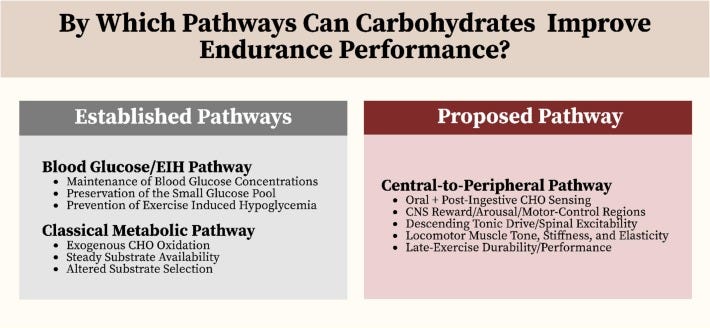
🍞 Exogenous carbohydrate oxidation increases as intake rises, but appears to approach a practical ceiling around ~105–120 g/h
↔️ Importantly, progressively higher intakes have not consistently produced proportional improvements in performance
🧬 Higher carbohydrate intake also does not appear to produce a clear dose-dependent reduction in muscle glycogen use
📈 In some studies, 100–120 g/h has still improved late-exercise durability or neuromuscular recovery despite similar glycogen utilisation
🧠 The authors therefore propose an additional mechanism: repeated oral and gut carbohydrate sensing may act as a neuroactive signal to the central nervous system
⚡ Carbohydrate in the mouth can activate reward-, sensory- and motor-related brain regions and has been shown to increase corticomotor output
🦵 The hypothesis is that sustained carbohydrate sensing could help preserve descending neural drive, spinal excitability and muscle tone late in prolonged exercise
🏃 In running, this might help maintain leg-spring stiffness and reduce the mechanical deterioration associated with fatigue
🚴 In cycling, the same mechanism could appear as better-preserved motor-unit discharge, joint stiffness and power output
🧪 However, the crucial link between carbohydrate sensing and preservation of spinal excitability or active muscle stiffness has not yet been demonstrated
⚠️ This is therefore a mechanistic hypothesis, not evidence that athletes should automatically push carbohydrate intake above 90–120 g/h
Conclusion
For endurance athletes, very high carbohydrate intakes may eventually prove useful for more than simply supplying fuel, potentially helping preserve late-race neuromuscular function, but this central-to-peripheral mechanism remains untested ✅
Reference
https://www.sciencedirect.com/science/article/pii/S0306987726003877?via%3Dihub

Performance Nutrition Digest is powered by Healthspan Elite ⚡️
Healthspan Elite is a science-led sports nutrition range developed in collaboration with leading experts to support athletic performance, recovery, and health.
Use code: TCDIGEST25 for 25% off at https://www.healthspanelite.co.uk/ 💪