


Effects of creatine supplementation on lean mass, muscle size and muscle performance during immobilisation and rehabilitation: A systematic review
Study Details
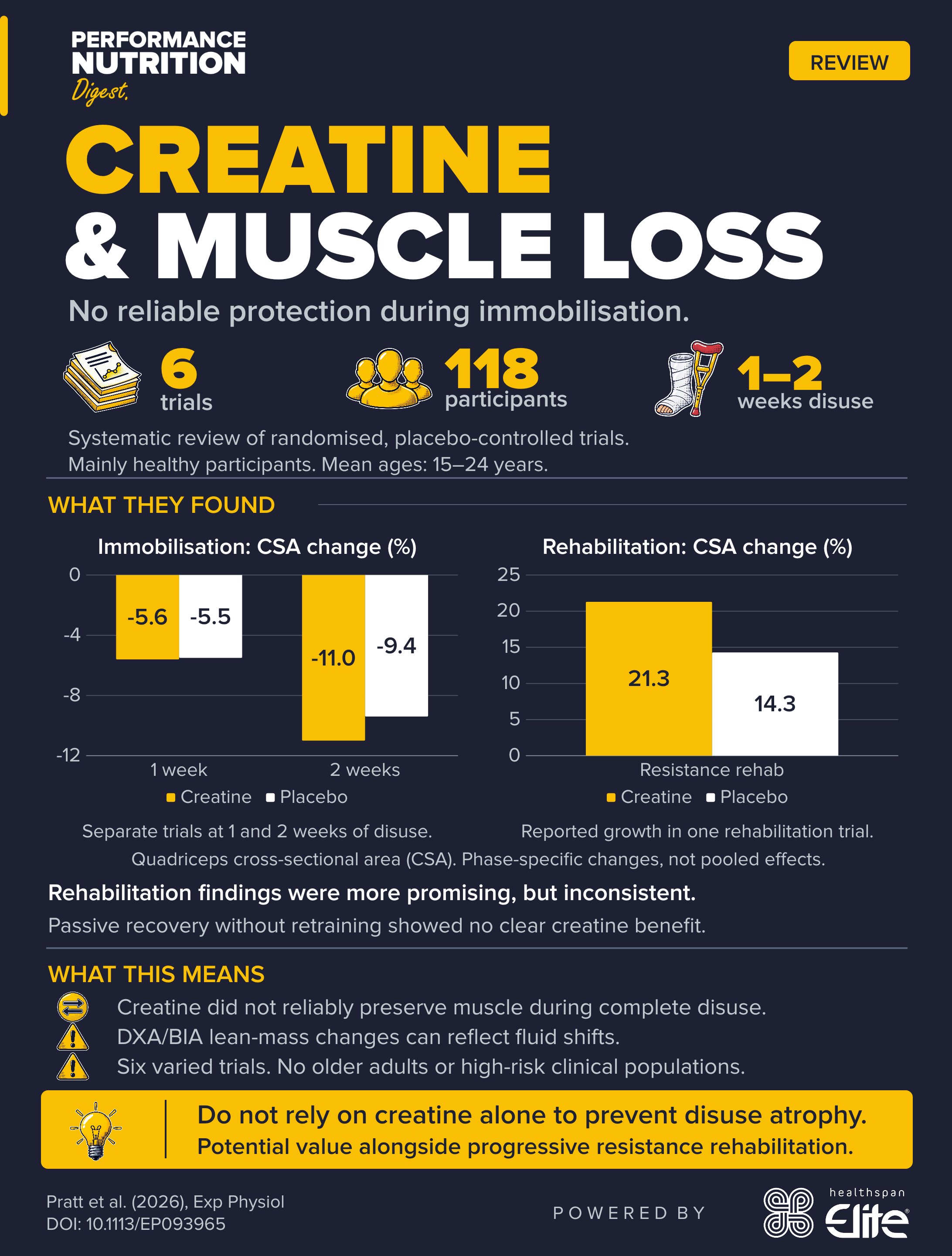
This systematic review included 6 randomised placebo-controlled trials and 118 participants, examining creatine during immobilisation and rehabilitation 🔍
Key findings ⬇️
Key Findings
🛑 Studies used 1–2 weeks of upper- or lower-limb immobilisation, mainly in healthy people aged 15–24 years
🥄 Protocols commonly used 20 g/day for 5–7 days, followed by 3–5 g/day during rehabilitation
📉 Direct imaging showed similar quadriceps losses with creatine and placebo: −5.6% vs −5.5% after 1 week and −11.0% vs −9.4% after 2 weeks
⚖️ Two studies reported better preservation of limb lean mass, but these used DXA or bioelectrical impedance, which can be influenced by fluid shifts and may not reflect preserved muscle tissue
💪 Effects on strength, power and endurance during immobilisation were inconsistent, with favourable findings mainly from small upper-limb studies
🏋️ Results were more promising once structured resistance rehabilitation began
📈 One study found greater quadriceps growth with creatine during rehabilitation (+21.3% vs +14.3%)
⚡ Other studies reported greater improvements in lower-limb lean mass, power, strength or muscular endurance, although benefits were inconsistent
↔️ Passive recovery without structured retraining showed no creatine benefit
⚠️ Evidence was limited and heterogeneous, with no trials in older adults or clinical populations at greater risk of prolonged muscle loss
Conclusion
For injured athletes, creatine should not be relied upon to prevent atrophy during complete immobilisation, but it may be worth continuing or introducing alongside progressive resistance-based rehabilitation, where the limited evidence is more encouraging ✅
Reference
https://pubmed.ncbi.nlm.nih.gov/42952382/

Performance Nutrition Digest is powered by Healthspan Elite ⚡️
Healthspan Elite is a science-led sports nutrition range developed in collaboration with leading experts to support athletic performance, recovery, and health.
Use code: TCDIGEST25 for 25% off at https://www.healthspanelite.co.uk/ 💪
On the dxa/bia caveat, the review's numbers make the split clear: the two studies using those methods reported smaller losses or preserved lean mass with creatine (−5.6% vs −8.9% lower limb, +0.9% vs −3.7% upper limb), while cross-sectional area imaging showed comparable losses. that makes the rehab result more interesting, since the 21.3% vs 14.3% quadriceps gain was measured as cross-sectional area, which is less exposed to the hydration issue.