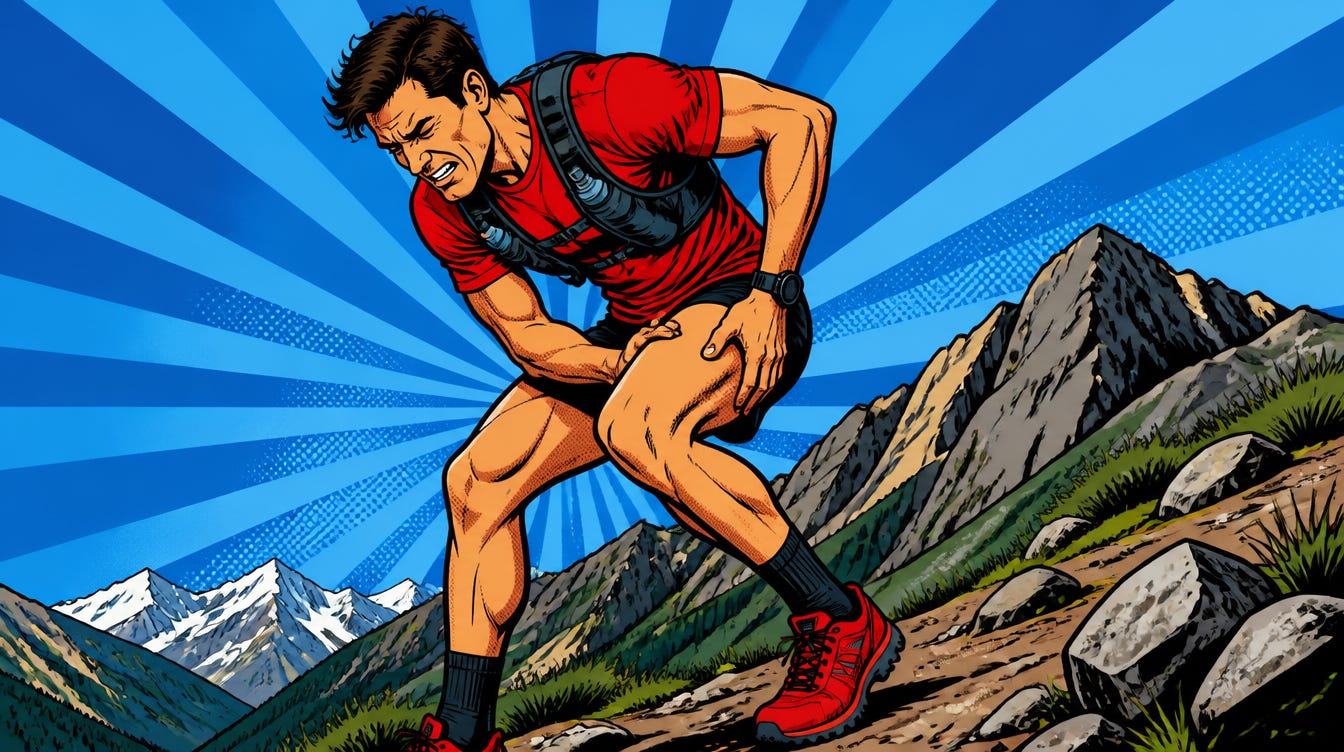
Is cramping caused by muscle damage - not dehydration? π§
Plus a key strategy for endurance athletes to reduce risk.
Muscle Cramping in Ultra-Trail: Dehydration and Electrolyte Depletion versus Muscle Damage
Study Details
This new study compared hydration status, electrolyte balance, muscle-damage markers, pacing and training background between ultra-trail runners who experienced exercise-associated muscle cramps and those who did not π
58 runners completed the analysis, including 37 men and 21 women π
Key Findings
β‘ 9 runners developed exercise-associated muscle cramps, giving an incidence of 16%
π¨ Cramping occurred in 22% of men versus 5% of women, although this difference was not statistically significant
π§ Body-mass changes were similar between runners who cramped and those who did not
π§ͺ Post-race urine specific gravity was also similar between groups, suggesting crampers were not more dehydrated
π§ Serum sodium concentrations did not differ between crampers and noncrampers
𧬠Post-race potassium was significantly higher in runners who cramped: 5.04 vs 4.66 mmol/L
π₯ Creatine kinase (CK) was substantially higher in crampers at both 24 and 48 hours after the race
π At 24hrs, CK averaged 5166 U/L in crampers versus 1940 U/L in noncrampers
π At 48hrs, CK remained higher at 3194 versus 894 U/L
π©Έ Lactate dehydrogenase was also significantly higher in crampers at both 24 and 48 hours
𦡠These elevated biomarkers suggest runners who cramped experienced greater exercise-induced muscle damage
β±οΈ Pacing indices did not differ between runners who cramped and those who did not
ποΈ Regular lower-limb strength training was less common among crampers: 55.6% versus 87.5% of noncrampers
πͺ This raises the possibility that greater muscular resilience from strength training could influence cramp susceptibility
Conclusion
The findings do not support greater dehydration or sodium depletion as the main explanation for cramping βοΈ
Small sample size but overall, cramping was more associated more strongly with subsequent muscle-damage markers than with dehydration or sodium depletion β
Reference
https://pubmed.ncbi.nlm.nih.gov/42172290/
Performance Nutrition Digest is powered by Healthspan Elite β‘οΈ
Healthspan Elite is a science-led sports nutrition range developed in collaboration with leading experts to support athletic performance, recovery, and health.
Use code: TCDIGEST25 for 25% off at https://www.healthspanelite.co.uk/ πͺ